
Entrepreneurship & Growth
3 Exciting Entrepreneurs: Software Reshaping Traditional Industries
24 November 2026 · 3 min read
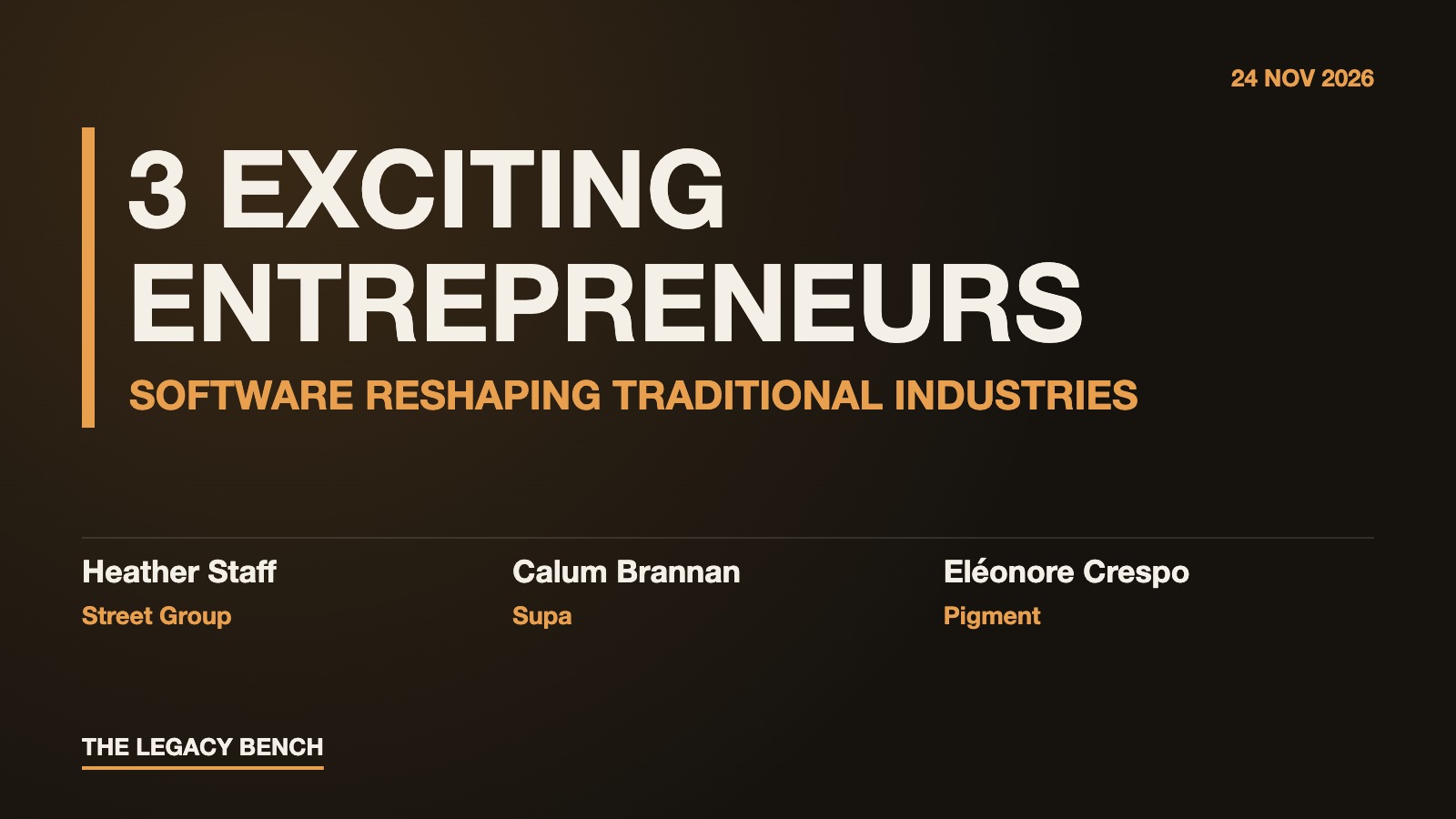
Some of the most valuable software companies are not inventing new industries. They are quietly modernising old ones. This week we are featuring three founders doing exactly that, in estate agency, residential block management and business planning.
One of them is building from Manchester, close to home for The Legacy Bench, one is in London and one is in Paris. Each has found a traditional market where better software can save people real time.
Heather Staff, Street Group (Manchester)
Heather Staff is the co-founder and co-CEO of Street Group, which she founded with her brother Tom in 2015. The business is based in Manchester.
Street Group builds CRM, lead-generation and AI agent tools for UK estate and letting agents, and employs more than 200 people. It is a very practical kind of technology: helping agents manage clients, find new business and spend less time on admin.
In July 2026 Hg made a strategic growth investment that values the business at more than £200m, with the founders remaining majority shareholders.
Street Group's story also shows the value of staying close to your customers. Building tools for a single industry, over many years, means understanding the day-to-day reality of the people using them. That kind of knowledge is hard for newcomers to copy.
Keeping majority ownership after a deal of that size is something many founders would love to achieve, and it is a credit to a sibling team that has built steadily for over a decade. Visit street.co.uk.
Calum Brannan, Supa (London)
Calum Brannan is the co-founder and CEO of Supa, based in London.
Supa is building an AI-native platform for residential block management. Its approach is distinctive: it acquires local property management firms and then automates tasks such as scheduling repairs, reconciling service charges and keeping compliance records.
On 4 November 2026 Supa raised £21m in seed funding, made up of equity co-led by 2150 and OpenOcean plus debt. It already manages about 20,000 homes through seven local firms.
Block management matters to everyone who lives in a managed block of flats, even if most residents rarely think about it until something goes wrong. That is often a sign of a market where better service and better technology can make a noticeable difference to people's everyday lives.
Buying established businesses and making them work better with technology is a model more founders are exploring, and Supa is a clear example of it. Visit supa.co.uk.
Eléonore Crespo, Pigment (Paris)
Eléonore Crespo co-founded Pigment with Romain Niccoli. The company is based in Paris, France.
Pigment offers an AI business-planning platform that large companies, including Danone, Siemens and Unilever, use to replace legacy systems. Planning budgets and forecasts is core work for every big business, which makes it a valuable place to build better tools.
In October 2026 Pigment raised a $250m Series E led by the EQT-managed Scaleup Europe Fund at a $2.3bn valuation. The money is mainly going into research and development.
The list of household-name customers also tells its own story. Persuading large organisations to move away from systems they have relied on for years is not easy, and it usually means the new product has to be clearly better, not just a little different.
Eléonore's story shows that "boring" business problems can support very big companies. Visit pigment.com.
Traditional industries can look unexciting from the outside, but they are full of people doing repetitive work with tools that have not kept up. Each of this week's founders spotted that gap and built something practical to fill it. That is a very achievable starting point for any founder.
What founders can take from this
Look for old processes that still frustrate people. Estate agency, block management and business planning are all traditional markets ripe for better tools.
Growth capital does not have to mean losing control. Street Group's founders remain majority shareholders after a £200m+ valuation.
Be creative about your model. Supa buys local firms and improves them, rather than only selling software to them.
Want more honest conversations with people building real businesses? Watch The Legacy Bench on YouTube: youtube.com/@thelegacybench.
Sources: