
Entrepreneurship & Growth
3 Exciting Entrepreneurs: The Deep Tech Builders Raising Big Rounds
22 November 2026 · 3 min read
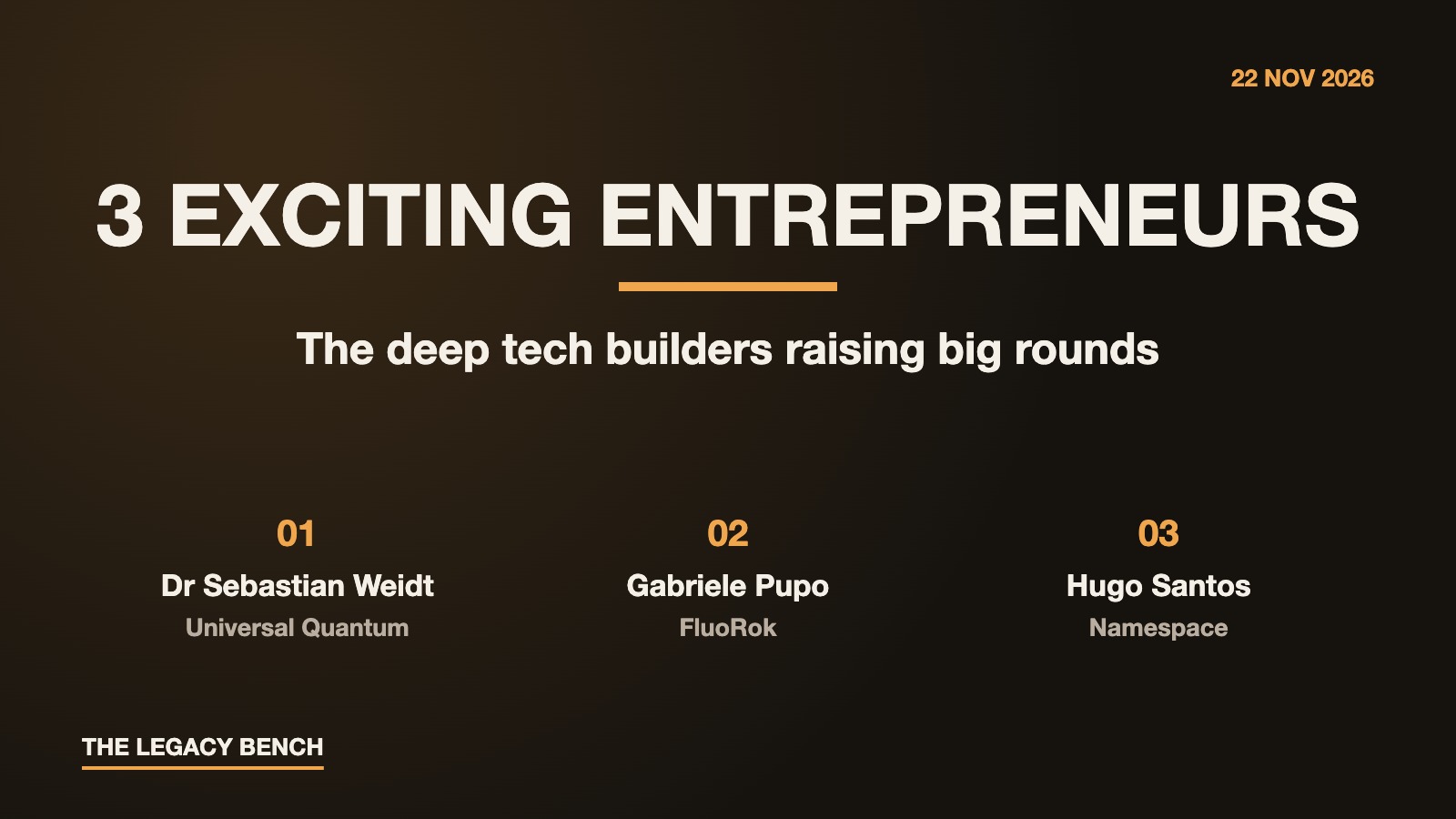
Deep tech is the hard stuff: quantum computers, new ways of making chemicals, the infrastructure that software runs on. It takes years to build and a lot of conviction to back. This week we are featuring three founders whose companies have just raised significant rounds to keep building.
Two are university spinouts from Sussex and Oxford, and the third is a Swiss company founded by a former Google engineer. Together they show that serious, science-heavy businesses can still attract serious investment.
Dr Sebastian Weidt, Universal Quantum (Haywards Heath, Sussex)
Dr Sebastian Weidt is the co-founder and CEO of Universal Quantum, based in Haywards Heath in the South East of England.
The company began in 2018 as a spinout from the University of Sussex. It is building fault-tolerant trapped-ion quantum computers on chips made in standard commercial foundries. That last part is important: using existing manufacturing rather than bespoke processes is one way to make a very ambitious technology more practical to scale.
On 8 October 2026 Universal Quantum raised a $100m Series A co-led by DCVC and Firgun Ventures. The company calls it the largest Series A by a UK-headquartered quantum firm, and it takes total funding past $125m.
For founders outside the quantum world, the interesting part of Universal Quantum's story is how it frames progress. Records, milestones and clear comparisons, such as the largest Series A of its kind, help people who are not specialists understand why a company matters. Being able to explain hard technology simply is a skill in itself.
It is a strong signal that a university lab idea can grow into one of the most closely watched companies in its field. Visit universalquantum.com.
Gabriele Pupo, FluoRok (Oxford)
Gabriele Pupo is the founder and CEO of FluoRok, a University of Oxford spinout.
FluoRok makes fluorochemicals without hydrogen fluoride. Instead of acid and high temperatures, it uses mechanical activation. Fluorochemicals feed into pharmaceuticals, agrochemicals and battery electrolytes, and those are the markets the company is targeting.
In November 2026 FluoRok raised an oversubscribed $30m Series A led by Orano Venture Fund and Supernova Invest. The money will go towards building demonstrator facilities, the step where a lab process has to prove it can work at a bigger scale.
FluoRok's next step, demonstrator facilities, is one every hardware and science founder will recognise. It is the moment a promising idea has to show it can work outside the lab, and it is often where the hardest lessons are learned. Raising an oversubscribed round going into that stage is a strong vote of confidence.
This is a classic example of a founder taking a better, safer way of doing something established and turning it into a business. Find out more at fluorok.com.
Hugo Santos, Namespace (Zurich)
Hugo Santos founded Namespace in 2022, after working as a principal engineer at Google. The company is based in Zurich, Switzerland.
Namespace provides a platform that speeds up software teams' build and test workflows. Its ambition is to become the infrastructure layer for AI coding agents, as more software is written with the help of AI.
On 5 October 2026 Namespace raised a $42m Series B led by Scale Venture Partners, just seven months after its Series A. Raising again that quickly is a sign of strong investor appetite for what the company is building.
There is a broader point here about timing. Hugo has positioned Namespace not only for how software is built today, but for how it is likely to be built as AI coding agents become more common. Building for where your market is going, as well as where it is now, is one of the hardest and most valuable things a founder can do.
Hugo's story shows how deep technical experience inside a large company can become the foundation for a startup. Visit namespace.so.
Deep tech can feel out of reach for most founders, but the habits behind these three stories are not. Each founder has a clear explanation of what they do, a credible next step and a reason for investors to believe now is the right moment. Those are lessons that apply whatever you are building.
What founders can take from this
Universities are powerful launchpads. Two of this week's three companies started life as spinouts, and both are now raising at scale.
Make the hard thing easier to build. Using commercial foundries, or replacing a hazardous process with a safer one, can be as important as the core science.
Momentum attracts investors. Namespace raised its Series B just seven months after its Series A.
Want more honest conversations with people building real businesses? Watch The Legacy Bench on YouTube: youtube.com/@thelegacybench.
Sources: