
Entrepreneurship & Growth
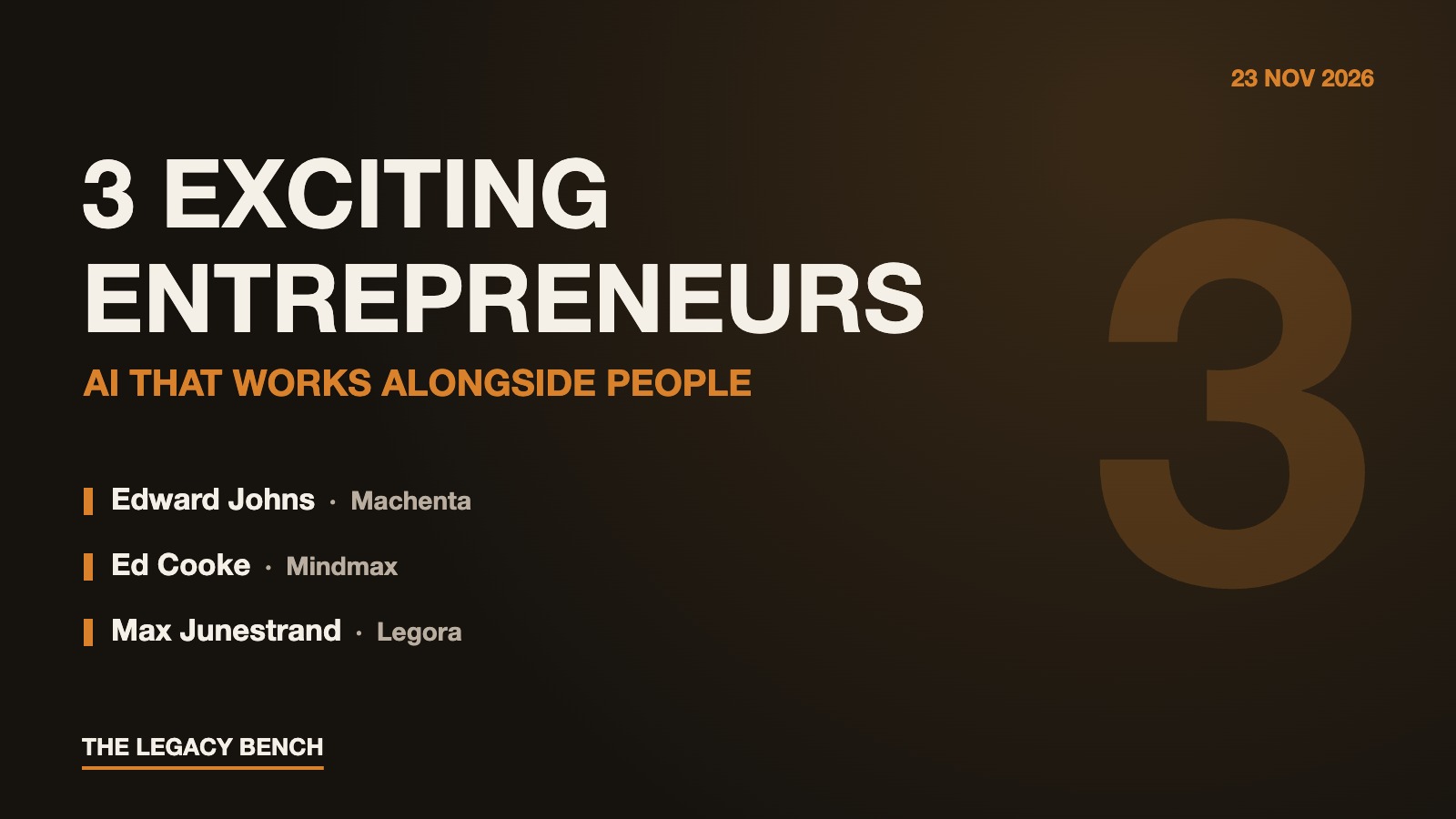
3 Exciting Entrepreneurs: AI That Works Alongside People
23 November 2026 · 3 min read
A lot of the noise around AI is about replacing people. This week's three founders are building something more interesting: AI that helps people do more, whether that is teaching a robot a new task, helping someone prepare for a professional exam or supporting lawyers in their daily work.
One is a London robotics company that has just come out of stealth, one is a fresh London edtech start-up, and one is a European legal tech business that has grown remarkably quickly. All three put people at the centre of the story.
Edward Johns, Machenta (London)
Edward Johns is a professor of robot learning at Imperial College London and the co-founder of Machenta, which he started with his PhD student Vitalis Vosylius. The company is based in King's Cross, London.
Machenta builds a simulation-trained AI model that lets robots learn a new physical task from a single demonstration. Show the robot once, and it can pick up the task, rather than needing to be painstakingly programmed for every new job.
On 27 October 2026 the company emerged from stealth with a $40m seed round co-led by Creandum and Union Square Ventures, described as the largest seed raised by a UK robotics company.
The bigger idea behind Machenta is accessibility. If a robot can learn from one demonstration, the people who know a task best, the workers who do it every day, become the ones who teach it. That is a very different picture from the fear that robots simply take over jobs.
It is a great example of academic research and a professor-student partnership turning into a company with real backing. Visit machenta.com.
Ed Cooke, Mindmax (London)
Ed Cooke co-founded Mindmax with Daniel Zohar. The pair previously worked together at the language-learning app Memrise.
Mindmax builds AI learning tools, starting with a conversational AI tutor for professional exam preparation. The idea is that the AI supports how people learn, rather than doing the thinking for them.
In November 2026 Mindmax raised a pre-seed round reported at £2.5m ($3.3m), led by Concept Ventures. Its angel investors include former Depop CEO Maria Raga and Helsing co-founder Torsten Reil.
There is something refreshing about a company that puts human learning first in an age when AI can answer almost any question instantly. The best tutors help you understand and remember, not just give you the answer, and that is the space Mindmax is aiming for.
Ed's story shows the value of a founding team that has built in the same space before. We could not find a company website to link to yet, so read more in Tech.eu’s report on the raise.
Max Junestrand, Legora (Stockholm and New York)
Max Junestrand is the co-founder and CEO of Legora, which operates from Stockholm, Sweden and New York.
Founded in 2023, Legora builds AI for lawyers. It is used by more than 140,000 legal professionals at over 2,400 law firms and in-house teams.
On 21 October 2026 Legora raised a $550m Series E led by Atreides Management at an $8.8bn valuation. The company says its annual recurring revenue now exceeds $200m.
Legora's numbers are eye-catching, but the more useful lesson for founders is focus. It chose one profession, understood its needs and built for it. Going deep into a single industry can create a product that people in that industry feel was made for them.
That is extraordinary growth for a company only a few years old, and it shows how much demand there is for tools that help professionals rather than sidelining them. Visit legora.com.
If there is one message from this week's three founders, it is that the most promising AI businesses are built around people: the worker teaching a robot, the professional preparing for an exam and the lawyer with too much to review. Keep the human at the centre and the technology has a clear purpose.
What founders can take from this
Build tools that make people better at their jobs. All three companies are growing by helping humans, not replacing them.
Your network and track record count. Founders who have worked together before, or who come from deep research, can move faster and earn trust sooner.
Pick a specific starting point. Mindmax began with professional exam preparation, not "learning" in general.
Want more honest conversations with people building real businesses? Watch The Legacy Bench on YouTube: youtube.com/@thelegacybench.
Sources: