
Entrepreneurship & Growth
London chip start-up Fractile raises $720m as investors back a new route to faster AI
13 November 2026 · 2 min read
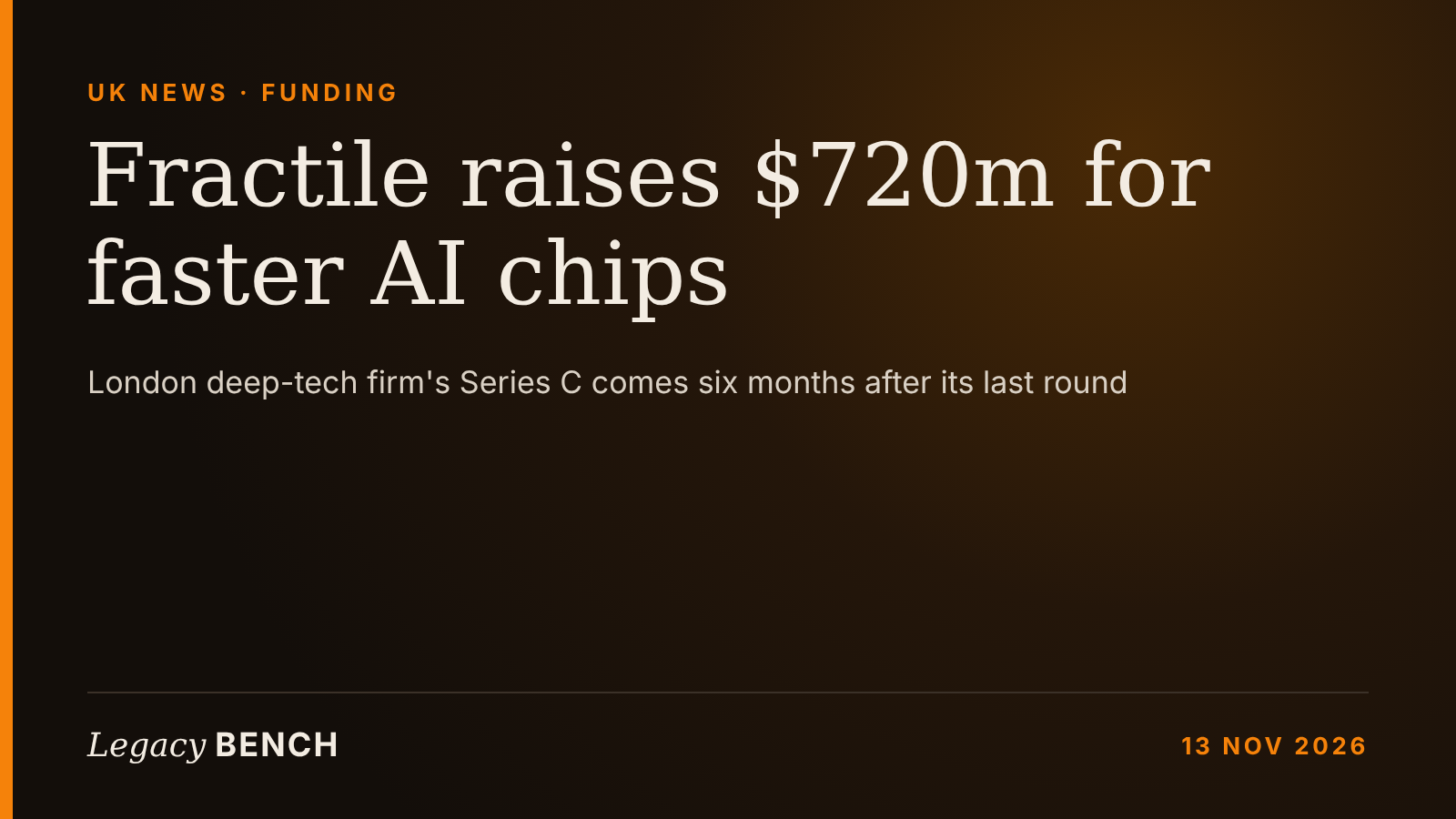
One of Britain's most closely watched deep-tech companies has just pulled off a remarkable funding round. Fractile, a London-based designer of chips for running AI models, has raised $720m in a Series C, only months after its previous raise.
What happened
Fractile was founded in 2022 by Walter Goodwin and Yuhang Song. Its approach rests on a simple idea: the biggest brake on AI performance is not raw computing power but how quickly data can move between memory and processor. To tackle that, the company stacks memory directly on top of logic, aiming for far higher bandwidth than the memory used in today's leading AI hardware.
The round was co-led by Thrive Capital, Founders Fund, Lightspeed and Redpoint. Other backers named in reports include BlackRock, Alphabet's CapitalG, DST Global, Balderton, the British Business Bank and the UK's Sovereign AI fund. The Financial Times reported a valuation of around $7bn, citing people familiar with the deal, although Tech Funding News notes the company has not confirmed that figure.
The jump is striking. In May, Fractile raised about $220m at a valuation of roughly $1bn. Goodwin told the FT that current frontier models are “drinking through a straw”, a neat summary of the memory bottleneck the company wants to clear.
Why it matters for founders
It is worth being clear about where Fractile is today. It has not yet shipped a production chip and has no disclosed revenue; its first commercial chip is due in 2027. Investors are backing a technical thesis and a team, not a finished product.
That is the lesson for founders. A sharply defined problem, explained in one sentence, can carry enormous weight with investors when it sits at the heart of a fast-growing market. Fractile did not pitch itself as a better version of what already exists. It named a specific constraint and built its whole company around removing it.
The round also matters for the UK. Public money from the British Business Bank and the Sovereign AI fund sitting alongside Silicon Valley's best-known firms suggests a growing willingness to back home-grown hardware, not just software.
What to watch
The company is hiring in London, Bristol, Palo Alto and Taipei, and earlier this year committed £100m over three years to UK expansion, including a hardware facility in Bristol. The real test now is turning prototypes into working silicon on time. Reports have also linked Anthropic to Fractile as a potential early customer, so watch for confirmed customer announcements as 2027 approaches. Competition is fierce, with several well-funded rivals chasing the same inference market.
Sources: