
Entrepreneurship & Growth
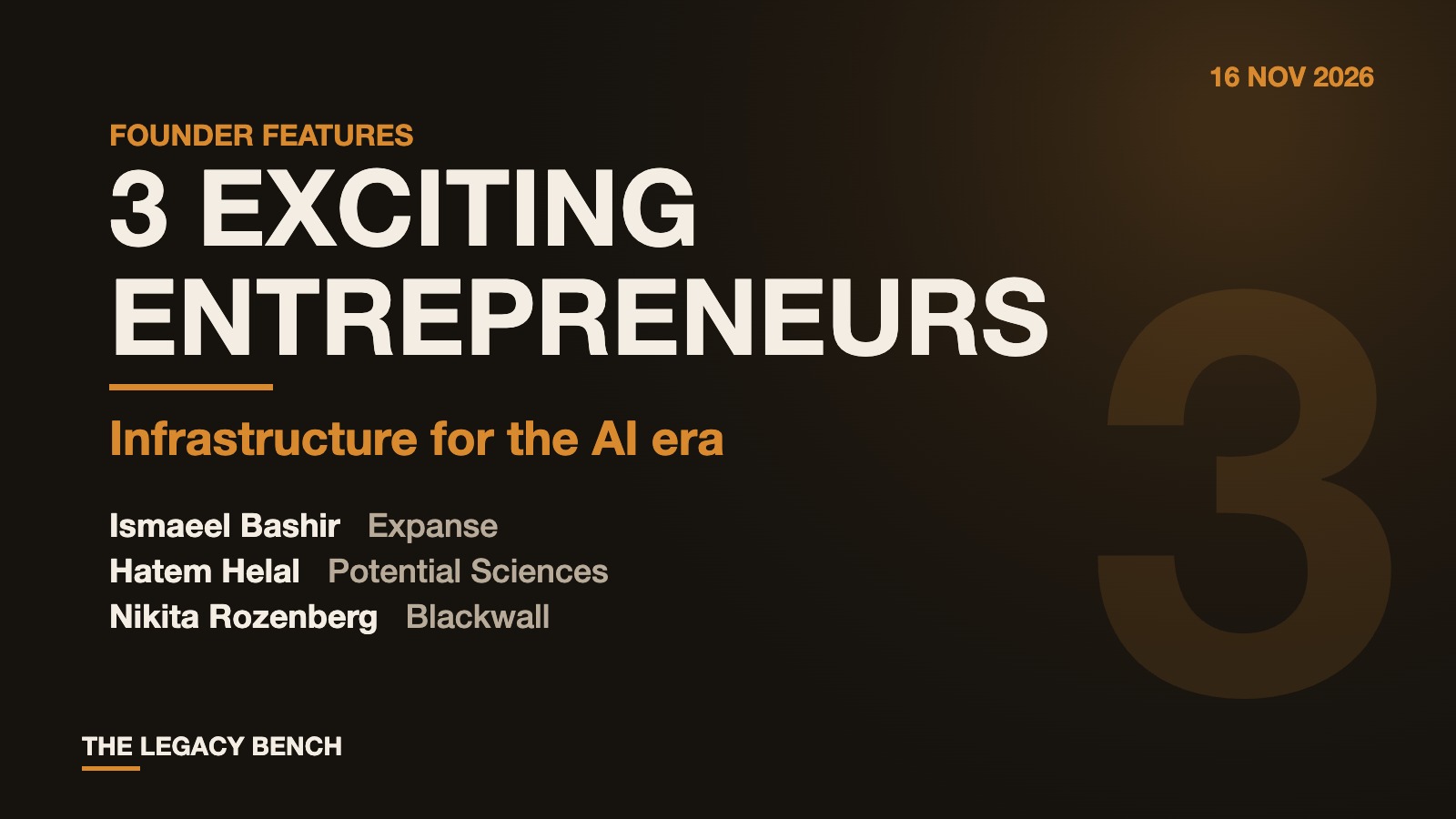
3 Exciting Entrepreneurs: Building the Infrastructure for the AI Era
16 November 2026 · 3 min read
Most conversations about AI focus on the chatbots and tools people use every day. Underneath them sits a huge amount of infrastructure: computing power, scientific models and security systems that most people never think about.
This week we are looking at three founders working at that foundation level. Two are UK-based, in Edinburgh and Cambridge, and one leads a fast-growing European cybersecurity company. One is cutting wasted computing power, one is using AI to rethink chemistry and medicine, and one is protecting websites as more and more traffic comes from AI agents rather than people.
These are technical businesses, but the problems they solve are easy to grasp: waste, slow discovery and online safety.
All three have also attracted serious investment in recent months, from seed funding to a government-backed round to a Series C valuing a company at more than $2bn. That level of backing shows how much weight investors are placing on the layers beneath the apps we see.
Ismaeel Bashir, Expanse
Ismaeel Bashir is co-founder and chief executive of Expanse, a company founded by four University of Edinburgh graduates. Expanse builds software that predicts how much GPU, CPU, memory and running time an AI workload will need before it runs, so that organisations stop paying for computing power they do not use.
In September 2026 Expanse raised a $5.3m seed round led by Crane Venture Partners, with PXN Ventures also taking part. The company says one production deployment found nearly $8m of idle compute capacity in a single month.
As AI gets more expensive to run, tools that make the most of existing hardware could save businesses a great deal of money, and energy too.
Read more about Expanse: DIGIT
Hatem Helal, Potential Sciences
Hatem Helal is founder and chief executive of Potential Sciences, based in Cambridge. The company uses AI models built on the laws of physics, rather than relying on lab data, to design new chemicals and medicines. Helal describes the work as having 'rebuilt quantum chemistry for GPUs'.
On 5 November 2026 the UK Government's Sovereign AI fund backed Potential Sciences in an eight-figure round, alongside Patrick Collison and other investors. The company is also being given access to the Isambard-AI supercomputer.
Discovering new medicines and materials is slow and costly. An approach that can explore chemistry on computers before anything is made in a lab could speed that up considerably, which is why government backing here is significant.
Read more about Potential Sciences: GOV.UK
Nikita Rozenberg, Blackwall
Nikita Rozenberg is co-founder and chief executive of Blackwall, formerly known as BotGuard, which is based in Estonia. Blackwall sells web security and traffic management to hosting and cloud providers, including bot mitigation, protection against DDoS attacks and tools to handle traffic from agentic AI.
In October 2026 Blackwall raised a $100m Series C led by AVP, at a valuation of $2.2bn. Existing investors Dawn Capital, MMC Ventures and Tera Ventures all returned for the round. The company plans to expand into 12 regions worldwide.
As AI agents browse and act online on people's behalf, telling good traffic from bad becomes harder and more important. Blackwall is betting that this problem will only grow.
Read more about Blackwall: Tech Funding News
What these three companies share is timing. Each is building for a world in which AI is not a novelty but a basic part of how businesses and researchers work. In that world, efficient computing, faster science and safer websites are not nice extras. They are essentials.
For founders, there is a broader point too. Big technology shifts create opportunities not only for the headline products, but for the many supporting businesses that make those products possible.
What founders can take from this
Sell the picks and shovels. Every AI product needs compute, data and security underneath it.
Show the saving in numbers. Expanse's claim of nearly $8m in idle compute in a month makes its value easy to understand.
Look ahead to tomorrow's problem. Blackwall is preparing for a web where much of the traffic comes from AI agents.
Want more real stories from people building businesses? Watch The Legacy Bench on YouTube: youtube.com/@thelegacybench.